What to Unpack First: Your First 48 Hours in a New Place
Forty-one boxes and one evening. What you actually need before you sleep, what you need before you leave the house tomorrow, and the boxes that can wait a month.

On this page
The truck pulled away an hour ago. You are standing in a room that is legally yours and does not feel like it, phone at eleven percent, looking at forty-one boxes that all say KITCHEN in the same marker. Somewhere in that pile there is a phone charger, a towel, and the coffee maker, and you are not going to find all three tonight.
There is a version of this evening that goes well, and it is not the version where you unpack the house. It is the version where you open six boxes on purpose and then go to bed.
The only question worth asking on the first night
Not what should I unpack — that question has no end and no answer at 11pm. The real one is narrower: what do I need before I sleep, and what do I need before I leave the house tomorrow morning?
That is usually nine or ten possessions. Not nine boxes. Nine possessions. Written down, the list is almost always some version of:
Something to sleep on, and something to sleep under
One towel per person, and the shower curtain, because a shower without one floods the floor
Toothbrush, toothpaste, and whatever medication anyone in the house takes
Phone chargers — all of them, because they are never where anyone thinks
Toilet paper, hand soap, one roll of paper towels
A change of clothes for tomorrow, already chosen
Whatever the coffee situation requires
One lamp or a headlamp, if the place has ceiling fixtures and no bulbs
The pet's bowl and food, if there is a pet
Everything else can wait until daylight, and most of it can wait a week. The first night rarely goes badly because the wrong box got opened. It goes badly because someone tried to open all of them.
If you packed a first-night box
Then this post is mostly congratulations. Find it, open it, stop.
The version that works is packed last and loaded last, so it comes off the truck first, and it is labelled to be obvious from across a dark room — a whole side covered in marker, or a strip of coloured tape that nothing else in the move has. A first-night box buried in the middle of the stack is a first-night box in name only.
If you are reading this before the move rather than during it, that is the highest-return twenty minutes available to you, and it sits alongside the rest of the pre-move sequence in organizing a home for a stress-free move. If the move is a dorm rather than a house, the whole sequence compresses into an afternoon, and the dorm version is here.
If you did not
Most people did not. Here is how to find nine possessions in forty-one boxes without opening forty-one boxes.
Do not start at the top of the nearest stack. Start with the boxes you packed last, which are usually the ones loaded last and therefore sitting nearest the door — bathroom and bedside contents get packed at the end because they are in use until the end.
Open the soft, light ones first. Bedding, towels and clothes are unmistakable by weight before you cut any tape, and they cover four of the ten entries on the list.
For everything else, cut the tape and look. Do not unpack. Fold the flaps back down and move on. An opened box you did not empty costs you thirty seconds; an emptied box costs you an hour and a floor covered in kitchen equipment.
Write on every box you open, in marker, what is actually inside it. You are already holding the marker and you are already looking in. This is the cheapest minute of the entire move and it is the one everybody skips.
Stop at nine. The list was the point.
Step four matters more than it looks. By tomorrow afternoon you will have opened maybe fifteen boxes, and if each one is now labelled honestly, you have re-labelled a third of the move for free.
The order for the rest of the week
Unpacking has a natural sequence and it is not room by room. It is by how much each room costs you while it is not working.
The bed. Assembled and made on day one, before anything else. It is the only part of the house that decides whether you function tomorrow.
The bathroom. Small, finite, and about forty minutes from empty to finished. Completing one room entirely on day one does something for morale that no amount of partial progress does.
The kitchen, in two passes. First pass is the six or seven pieces you use daily — kettle or coffee maker, one pan, plates, cutlery, the can opener. Second pass is everything else, later in the week. Placing a whole kitchen at once is wasted effort, because those storage decisions all get redone once you have actually cooked in the room.
Clothes. Hanging clothes go up as they are. Folded clothes can live in the box they arrived in for a fortnight and nobody will die.
The room where you work, if you work from home and Monday is real.
Everything else, over the following weeks, in whatever order the household argues its way into.
Give yourself a week for the parts that matter and a month for the rest. The boxes still stacked in the second bedroom four weeks in are not a personal failure — they are the normal state of a house four weeks after a move.
The boxes you should not open
Some boxes are better left sealed, and spotting them early is a real saving.
Anything seasonal — winter coats in August, holiday decorations, ski equipment — goes straight to wherever it will live and stays shut. Write the season and the room on the outside and do not open it to check. The same goes for the paperwork you have not needed in three years, the sentimental box you know will take four hours because every item in it is a conversation, and anything you packed while thinking I should really deal with this. You should. Not this month.
If any of those are heading to a storage unit rather than a closet, that is its own problem with its own approach — inventorying a storage unit covers doing it without emptying the place out.
The habit that makes the next move different
Here is the uncomfortable part. Everything above is damage control. The reason the first night is hard is a decision made three weeks earlier, while the boxes were being filled and nobody wrote down what went into them — and it is genuinely hard to do at the time, because a full contents list in marker on the side of a box is slow, and you are taping up the fortieth box at midnight.
The fix is not better handwriting. It is that the record should not live on the outside of the box at all.
Cratify was built around that gap. You photograph a box's contents as you fill it — Multi-Scan takes one photo of the whole open box, detects the separate possessions in it, and gives each one its own crop of that single photo, so a full box is a few seconds rather than a written list. Each box gets a printable QR label and a permanent three-word name like Happy Blue Tiger, so scanning the label on the side shows you what is inside without cutting the tape. Collections handle the first-night list directly: make one called open first, check entries off as they surface, and the list lives on your phone instead of in your head at 11pm.
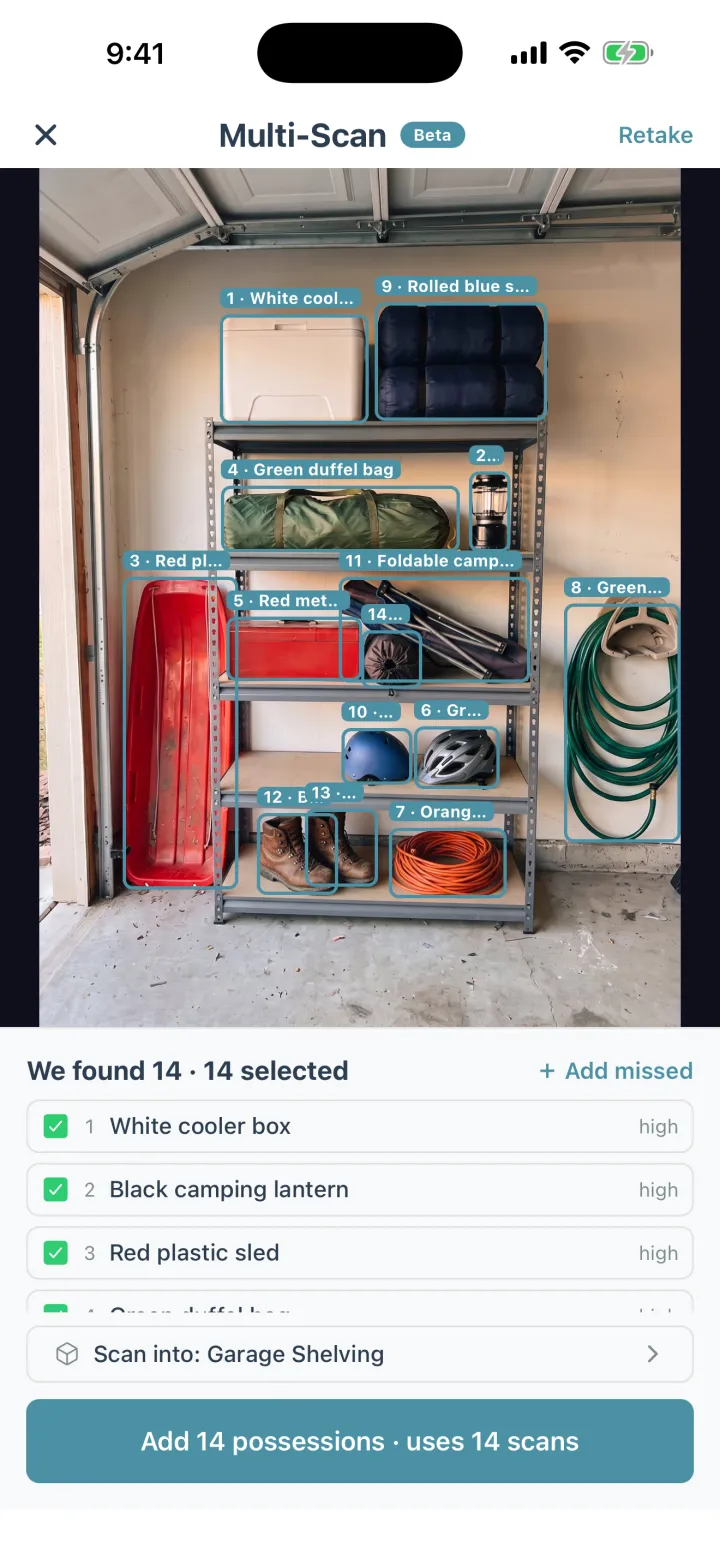
Multi-Scan names up to 15 possessions from one photo.
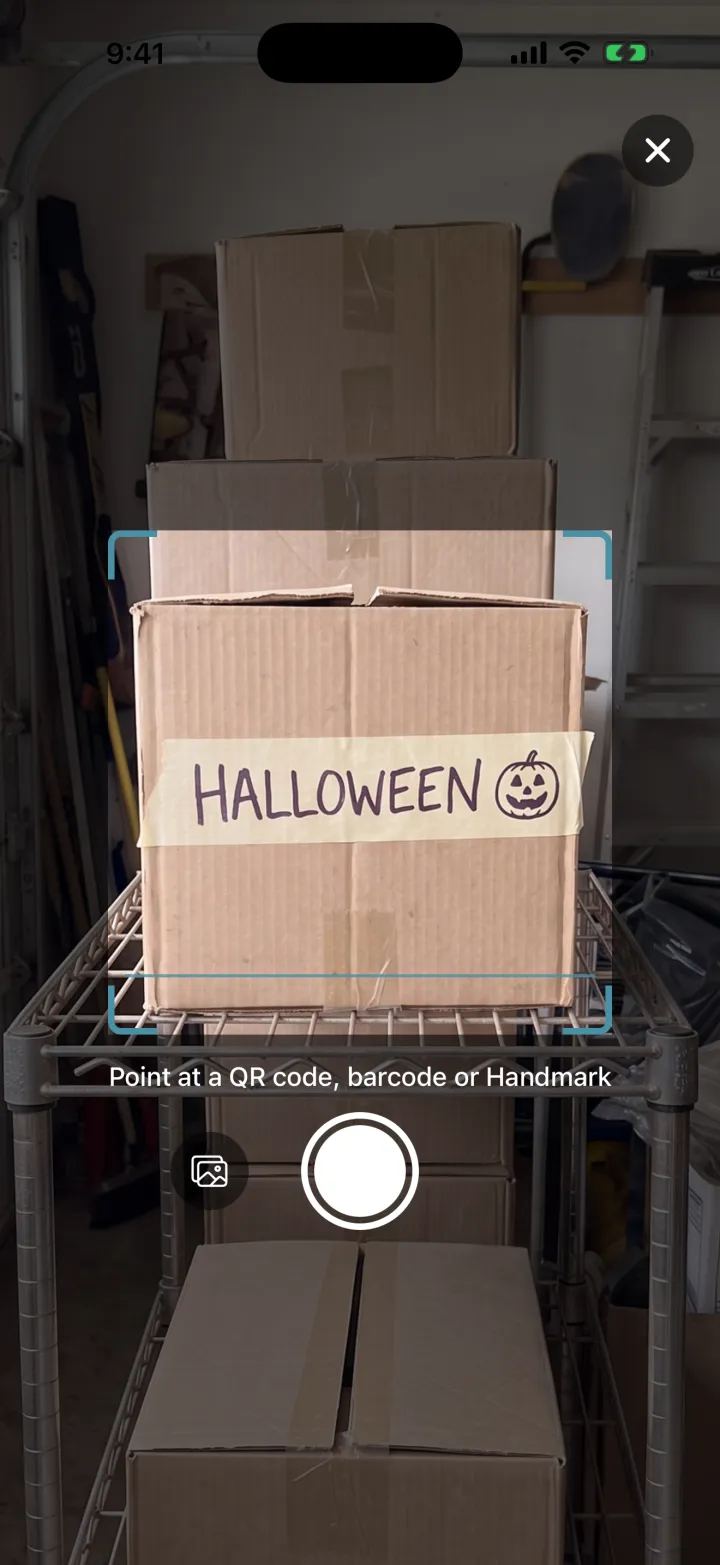
Scan reads QR labels, barcodes and what you already wrote on the box.
On the far end of the move, search is the part that actually changes the week. Typing "shower curtain" and being told which box it is in is a different evening from standing in a hallway doing archaeology.
None of that helps you tonight. Tonight you are opening the soft boxes and looking for towels, and that is fine — that is what tonight is for. But there is a version of the next move where you arrive, scan three labels, and have the bed made in twenty minutes, and the only difference between the two is a habit that costs ten seconds a box at the packing end.
Cratify is free to try.
Find any box without opening it
QR labels, photo inventory, and search for every box in the pile — free to try.