How to Organize a Storage Unit So Everything Stays Reachable
The layout you pick in the first ten minutes decides whether every future visit is five minutes or forty. Where the aisle goes, what loads first, and what waits at the back.

On this page
The roll-up door is open, the truck is backed in at an angle that felt smarter twenty minutes ago, and your friend is standing at the tailgate holding one end of a sofa, asking where it goes. It is four in the afternoon. You have maybe two hours of daylight and a finite amount of goodwill. What you decide in the next ten minutes is what every visit to this unit will cost you for as long as you rent it — five minutes, or forty.
Almost nobody plans the inside of a storage unit. It gets filled in the order the truck was loaded, which was the order the house came apart in, and the result is a solid rectangle of cardboard with the camping gear behind the mattress behind the bookshelf. It holds everything you own. You just cannot reach any of it without unloading half of it onto the driveway first.
The fix costs nothing and takes ten minutes. Before the first box crosses the threshold, answer three questions: where the aisle goes, what belongs against the back wall, and what has to stay within arm's reach of the door.
If the unit is already packed solid and you have found this a year too late, do not start hauling — the two-visit method for inventorying a full unit gets you a usable record without emptying anything. And if you have not signed the lease yet, the layout below needs floor space the volume math leaves out, which is part of choosing the size.
Decide where the aisle goes before anything comes off the truck
This is the only decision you cannot fix later, because by the time you notice, there are 14 boxes standing where the aisle should have been.
An aisle is not wasted rent. It is the difference between a unit you can use and a room you own one key to. Make it shoulder width at the narrowest — enough to walk in carrying something — and wider if you will ever bring a hand truck through.
Two shapes, two answers:
A unit about as wide as it is deep: run the aisle straight down the middle, with stacks on both sides. Everything ends up one step from the centre line.
A long, narrow unit: run the aisle down one side and keep a single stack against the other. You lose less floor, and you can still walk to the back.
Either shape, the aisle reaches the back wall. An aisle that stops two thirds of the way in is a corridor to nowhere, and the far corner becomes the place possessions go to be forgotten.
Mark it before you load. Two empty boxes set down as goalposts will do — the point is that the person carrying the sofa can see the line and will not put a foot in it.
Sort on the ground, not in the unit
The truck was packed for the truck. Nothing about that order matches the order you will want your belongings back in, and if you try to sort inside the unit you will spend the afternoon shuffling the same six boxes between two walls.
So sort outside, in the ten minutes everyone skips. Three piles on the ground in front of the door:
Back wall — anything you are confident you will not open for a year or more. Keepsakes, records, furniture waiting for a bigger place, the boxes with a year written on them.
Side stacks — seasonal and occasional. Camping gear, holiday decorations, off-season clothing, the window fan, the sports equipment that rotates.
Front row — the next six months. Whatever you already know you are coming back for, plus anything you feel unsure about. Uncertainty belongs at the front.
You will not get this perfectly right, and you do not need to. There is exactly one expensive mistake, and it is putting a front-row item against the back wall. Everything else is a short walk.
Load in reverse order of need
The rule is one line: last out goes in first. Then load in three passes, back to front.
Pass one, the back wall
Heaviest boxes on the bottom against the back, with the long-term stacks built on top of them. Spend the strength here while everyone is still fresh, because these are the boxes nobody wants to move twice.
Furniture that can stand on end goes in during this pass too, along a side wall rather than out in the middle. A bookshelf on its side becomes a surface you can stack against, and a mattress upright against a wall costs you a few inches of floor instead of an entire footprint.
One placement worth knowing: keep anything you would be sad to lose off the bare concrete and away from the door wall. Exterior and door-facing walls tend to see the widest temperature swings and the most dust. That is a rule of thumb rather than a promise about your particular facility, so ask about climate control if the contents warrant it.
Pass two, the side stacks
Stack to a height you can take down alone. The working test: the top box of any stack you might actually open should come off without a stepladder and without waiting for someone else to be free. Chest height is about right for anything in the front half of the unit. The long-term stacks at the back can go higher, because you are not going in there.
Uniform box sizes stack straight and stay put. Mismatched sizes lean, and a leaning stack is one you quietly stop pulling from.
Pass three, the front row
Load the front row last, one stack deep, with nothing behind it. Single depth is the entire point. If you have to move a box to reach a box, the front row has already failed at its only job.
Leave the top of this row open rather than stacked to the ceiling. It is the surface you will set a box on while you look inside it, and without it every future visit starts by hunting for somewhere to put the first box down.
Turn the labels toward the aisle as each box lands
A label facing the wall is a blank box, and the only cheap moment to fix that is while the box is still in your hands.
Two habits that pay for themselves here. Write the same identifier on the top of the box and on one side, because you read the tops of front-row boxes looking down and the sides of tall stacks looking across. And make the marked side the one that faces the aisle when you set it down — deliberately, every time, not when it happens to work out.
What to write on a label is a separate question with a real answer. If you are weighing whether marker on tape is the right tool for a unit you will hold for years, we have compared handwritten labels against QR labels on their own terms.
Leave the space you are going to need
No storage unit is loaded once. Something always follows — the second carload, the furniture from a parent's house, the seasonal swap in October.
So stop before the unit is full. Leave the last few feet of the front row genuinely empty, not "we will squeeze it in" empty, and the next load lands in a spot that was waiting for it instead of in the aisle. A unit packed to 90 percent on day one is a unit whose layout survives about six weeks.
Draw the map before you pull the door down
Five minutes, at the end, when you least want to spend them.
Stand in the aisle and photograph each zone in a fixed order — back wall, left, right, front row — so that in November you know the second photo is always the left stack. Then write one line for each zone saying what is in it. That line is what turns "somewhere in there" into "back wall, right side, third from the bottom."
This is a map, not an inventory. You are recording where the zones are, not what is inside every box, and that is the right amount of work to do with a truck still in the driveway.
It is also the step an app is honestly better at than a note, because a note only stays useful if you were disciplined about writing it. Photograph an open box and Cratify identifies the contents into a list you can search from home, so "where is the camp stove" becomes a question you answer from the sofa rather than a drive across town. Every box also gets a permanent three-word name — Happy Blue Tiger — that you can say out loud to whoever is doing the pickup, and that still holds when the tape label has faded. A printed QR label on the aisle-facing side means a scan shows what is inside without opening the box, which is the promise the whole layout was making. And the unit can be shared with another person at the location level, so whoever else has the gate code is reading the same list you are.
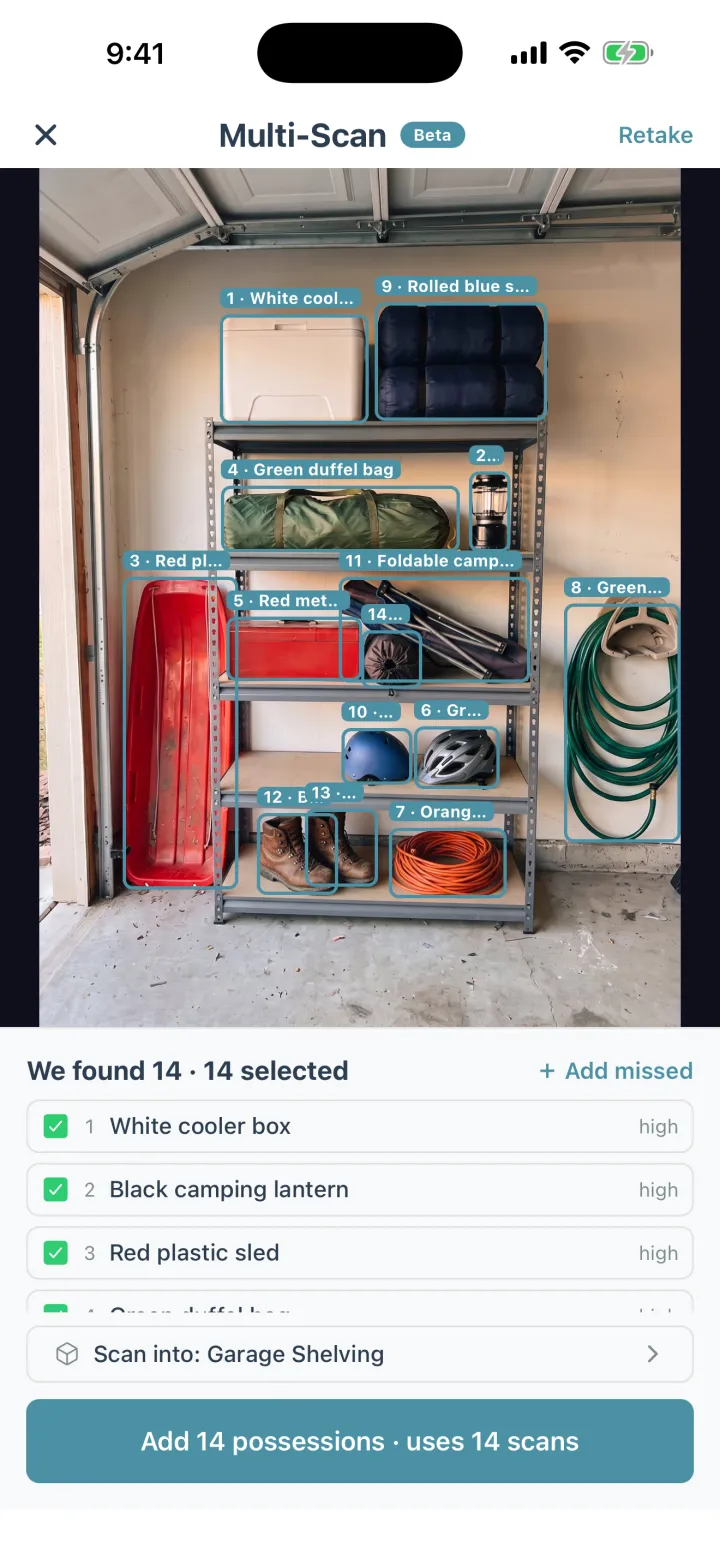
Multi-Scan names up to 15 possessions from one photo.
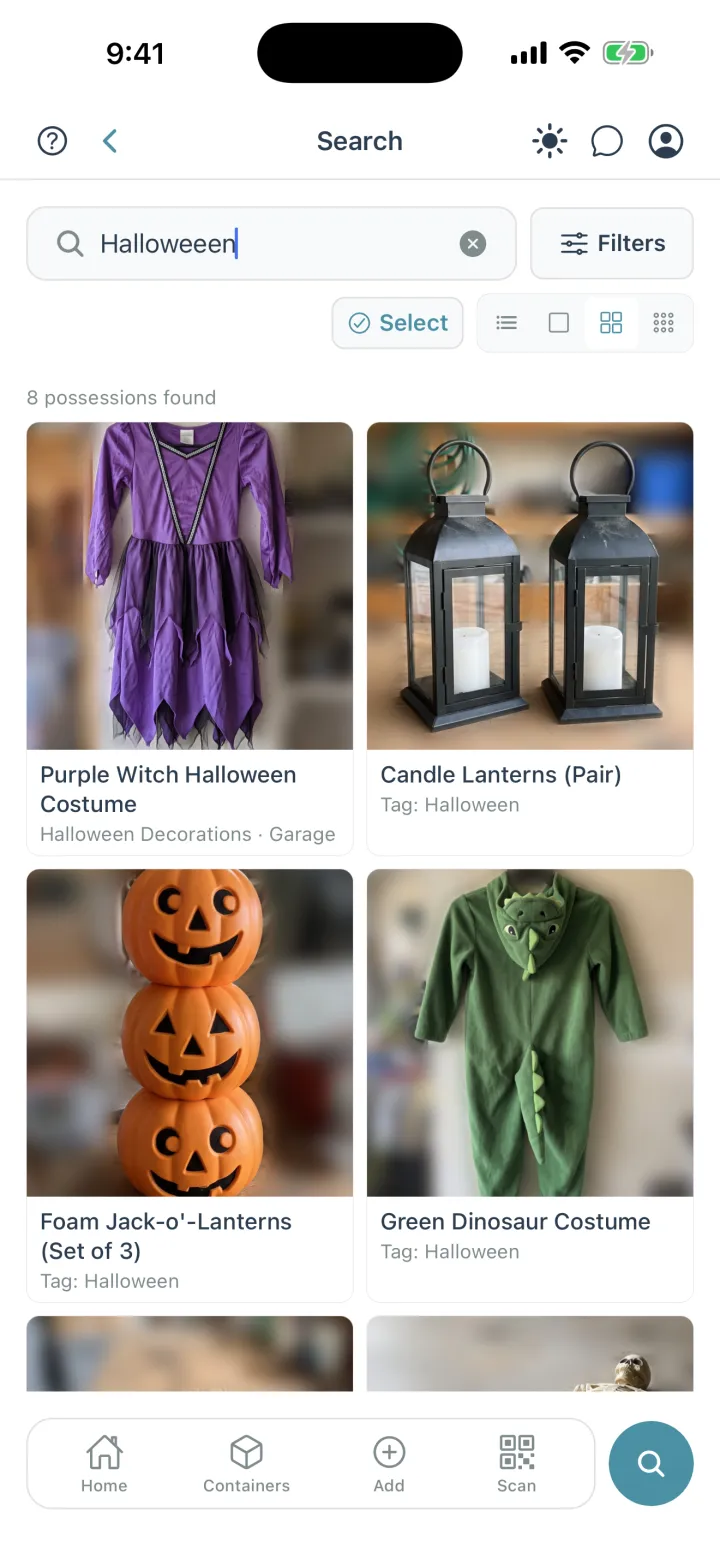
Search forgives typos: “Halloweeen” still finds every Halloween possession.
What the layout buys you
The test is not how the unit looks on loading day. Every unit looks fine on loading day, packed tight and square, and that is exactly the version that fails in February.
The real test is the Tuesday you need one specific box. You unlock the door, walk to the back on an aisle that is still there, take one box off a stack you can reach, put the door down and drive home. 11 minutes, no driveway, nothing else moved.
That visit was decided months earlier, in the ten minutes before anything came off the truck, by someone who put an aisle where the boxes wanted to go.
Keep every box reachable
QR labels and photo inventory so the box at the back stays findable — free to try.