How to Organize School Papers and Artwork Without Keeping It All
The backpack brings home four different kinds of paper, and only two are worth keeping. A ten-minute Friday sort, a keep rule set in advance, and what to photograph.

On this page
- Four kinds of paper arrive in one pile
- Put a landing spot by the door before the first Friday
- The Friday sort takes ten minutes
- Decide the keep rule while nothing is at stake
- Photograph the art so the photo is worth having
- Where the record lives after the photograph
- The end-of-year pass, and the August version
- The part nobody mentions
The backpack comes home on the second Friday of the school year and it is already full: a permission slip due Monday, a newsletter about picture day, four worksheets with stickers on them, a drawing of the family dog with six legs, and a form asking for the same emergency contacts you filled in three weeks ago. Multiply that by two children and thirty-six weeks, and school paper is the largest volume of anything a house takes in all year.
Most advice on this says to make a decision on every sheet the day it arrives. That is correct, and nobody does it. What actually holds up is sorting by what a piece of paper is for rather than by what it looks like, and setting the keep rule once — now, in August, while nothing is at stake — instead of forty times a year with a tired seven-year-old watching you hold their drawing over the recycling.
Four kinds of paper arrive in one pile
The reason the pile feels impossible is that it is four different problems stacked on top of each other, and each one has a different answer.
Paper with a deadline
Permission slips, picture day envelopes, order forms, the field trip payment, the reading challenge that has to be signed. It is the smallest category by volume and the only one where missing it costs something real. It has to stay visible, and it has to leave by its date.
Paper that is a record
Report cards, immunization forms, class placement letters, standardized test results, any IEP or 504 paperwork. Small in volume, long in life. Some of it gets asked for years later by a school in another state, and none of it is easy to replace.
Paper that is practice
Worksheets, spelling tests, math drills, the reading log, the handwriting sheets. This is most of the pile by weight and almost none of it is worth keeping past the week it was done. It is evidence that practice happened, not the practice itself.
Paper that is art
Drawings, paintings, the pasta necklace, the paper plate turkey, the self-portrait where everyone has enormous hands. This is the category the whole problem is really about. Nobody has ever agonised over a spelling test.
Once the pile is four piles, three of them have obvious answers. The fourth is a decision you get to make in advance.
Put a landing spot by the door before the first Friday
Paper collects wherever it first lands, which in most houses is the kitchen counter — and a counter has no capacity limit, which is the whole trouble with it. Give the paper somewhere to land that does:
One shallow open container per child, within reach of where the backpacks drop. A magazine file, a slim drawer, a labelled folder standing in a rack — anything with a visible edge you can see over.
One clip or hook for deadline paper, at adult eye level, somewhere you walk past daily. Deadline paper never goes in a container. Out of sight is the entire failure mode.
The recycling within arm's reach of both. Two rooms away and the sorting quietly stops happening by October.
That is the whole setup. It works because it removes the moment where a sheet of paper has nowhere to go and therefore goes on the counter.
The Friday sort takes ten minutes
Once a week, before the weekend swallows it:
Empty both backpacks completely onto the table, including the crumpled layer at the bottom.
Handle the deadline paper first. Anything due before next Friday gets signed, paid or written on the calendar now, then leaves the house or goes on the clip.
Records go straight into the records folder. Not into a pile for later — later is where records go missing.
Practice paper: let the child choose one or two to keep, then recycle the rest with them there. A child who is part of the decision stops policing the recycling.
Art goes in the to-photograph spot, and the photographs happen once a month rather than every Friday.
Ten minutes a week is about six hours across a school year. The alternative is one appalling afternoon each June with four hundred sheets on the living room floor and no memory of which year any of it came from.
Decide the keep rule while nothing is at stake
A rule that survives a real school year is a number or a container, never a judgment. "Keep the special ones" is not a rule; every parent's definition of special expands at the exact moment the drawing is in their hand.
What works is a physical constraint decided in advance: one folder per child per school year, and it has to close. Ten to fifteen pieces fit in a folder like that, which is more than enough to show what a child was like at six. When the folder is full, something has to come out for something better to go in — and that comparison is far easier to make than the original decision, because it is between two real drawings instead of between one drawing and a vague future regret.
Write the rule down somewhere you will see it in February. It is not a rule you will remember. It is a rule you will be relieved to find.
Photograph the art so the photo is worth having
Most photographed artwork is photographed badly and never looked at again: shot at an angle, in the evening, on a patterned rug, with half a sock in the frame. Fifteen seconds of care is the difference between an archive and a folder nobody opens.
Flatten it and shoot it square
Put the piece on a plain floor or table near a window, in daylight, flash off. Stand directly over it rather than beside it, so the rectangle stays a rectangle. Fill the frame with the paper and crop out the floor. If it is curled, hold the corners down with two books just outside the frame.
Get the name and the date into it
Before photographing, write the child's name, the date and the grade on the back in pencil. Six years later a drawing without a date is charming and completely anonymous, and no amount of squinting brings back whether that was kindergarten or first grade.
Shoot the three-dimensional pieces from one angle
The clay pinch pot, the diorama, the painted egg carton caterpillar. Set it against a plain wall at the child's eye level and take one good photograph rather than six mediocre ones. For most families the photograph is the keepsake, and once it exists the piece itself can leave without anybody feeling much about it. The same rules that make a photograph of a possession worth keeping apply here without a single change.
Where the record lives after the photograph
A folder of photographs on a phone beats a box in the garage, but only if you can find second grade in it later. That is the part Cratify was built for. You photograph the drawing and the app identifies what is in the photo, so it arrives already described instead of as a filename with a number in it. Report cards and immunization forms file as the Document possession type, which carries its dates as structured detail rather than as something you have to remember.
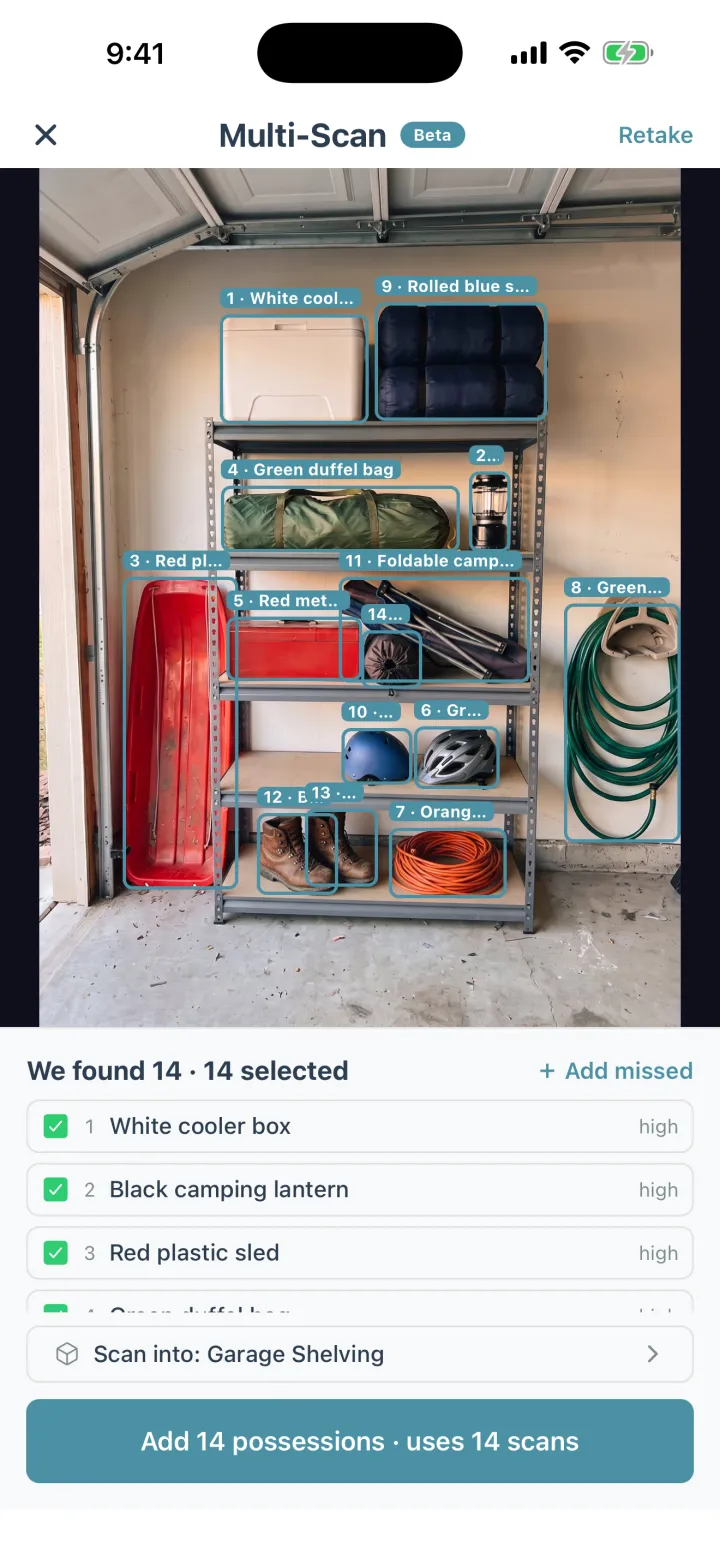
Multi-Scan names up to 15 possessions from one photo.
From there, a Collection per child per school year — "Amelia, second grade" — holds that year's keepers in one list you can pull up in a minute, whether the original is in a folder in the closet or was recycled in March. And when something does go, it can be archived with a reason rather than deleted, which matters more than it sounds like it should the first time you go looking for a drawing you decided not to keep.
The physical keepers still want a home: one Container per child, in a closet or on a shelf, labelled on the side that faces out. A printed QR label means you can see what is inside without pulling the folder down and undoing three years of order to check.
The end-of-year pass, and the August version
June is when the paper arrives all at once — the emptied desk, the portfolio, the yearbook signed by eleven people. Run the same sort, then close the year: the folder gets the year written on it, the photographs get their Collection, and the practice paper leaves.
August is the quieter and more useful pass, because it is when you find out what you already have. Going through last year's folder before the new one starts is the same move as checking the supplies you already own before the shopping trip, and it works for the same reason. It is also the natural moment to run the sort of outgrown clothes by size, since both jobs answer the same question about a child who grew four inches since May.
The part nobody mentions
Two honest notes to finish on.
You already have a backlog — three years of paper in a box in the closet, or in four boxes across three closets. Do not start there. Start with this year, get the weekly sort running, and set the backlog aside for one winter afternoon with a camera and a podcast. Starting with the backlog is how the whole project dies in week one.
And the sorting is not neutral to the person who made the drawings. A child who finds their work in the recycling learns something you did not mean to teach. Either sort with them, on the terms above where they pick what stays, or sort after they are asleep and let the recycling leave with the bags. Both are fine. The middle — sorting in front of them without asking — is the one that goes badly.
Four piles, one folder that has to close, and a photograph with the date on the back. That is the entire system, and it holds up in February, which is the only test that matters. Cratify is free to try.
Keep the year without keeping the pile
Photograph the drawings as they come home, file the report cards as Documents, and find second grade again in six years — Cratify is free to try.