How to Organize a Garage So You Can Park in It
The car has been on the driveway since May. Getting it back inside is not a tidying job — it is a measurement problem, and measurement problems finish. Here is the order that works.
On this page
The car has been on the driveway since May. You know exactly how long, because there is a clean rectangle of concrete out there where it sits, and because the garage door goes up on a wall of cardboard, a bike with a flat tire, half a bag of potting soil, and the paddling pool nobody has emptied since July.
Getting the car back inside is not a tidying job. Tidying has no finish line, which is why the garage has already survived three attempts at it. Parking is a measurement problem, and measurement problems end. There is a rectangle of floor the car needs, a few inches of clearance around it, and everything else in the garage has to live somewhere that is not that rectangle. That is the entire project, and it is why this version of it actually finishes.
Measure the car before you touch the garage
Most garage weekends start with a pile in the middle of the floor. Start with a tape measure instead, and start outside.
Length and width of the car, measured mirror to mirror rather than door to door. The mirrors are the widest point on most vehicles and they are what you clip.
How far the driver's door swings open, measured from the side of the car, with a person actually getting out of it.
The trunk or hatch at full lift. This is the measurement everyone forgets, and it is why so many carefully organized garages have one shelf with a dent in it.
The width of the garage door opening, which is usually narrower than the garage itself.
Ceiling height at its lowest point, including the door track and the opener motor.
Then tape the footprint onto the floor. Painter's tape, the actual rectangle, plus the door swing and enough room to walk around the hood. It takes ten minutes and it reframes the whole weekend, because from that point on you are not deciding whether the garage is tidy. You are deciding whether something is inside the tape. Everyone can see that answer, including whoever else lives there and has opinions about the exercise bike.
Empty the perimeter, not the middle
Here is the part that rarely gets written down: the floor you need is the floor along the walls, and it is the floor that is hardest to reach. A garage fills up from the door inward, so the perimeter — the only surface that can take shelving — is buried behind everything that arrived later.
Which means the sort cannot happen in place. Pick a dry day with nothing scheduled after it. Everything comes out onto the driveway, unsorted and unevaluated, just out. A two-car garage that has been accumulating for five years takes most of a Saturday to empty, and it looks considerably worse before it looks better. That is normal, and it is the point. You cannot plan around a wall you have not seen since you moved in.
While the garage is empty, do the ten minutes of work that is only possible in this window: sweep it, find the studs and any existing anchor points, and note where the outlets are. Nobody enjoys moving a loaded shelf in November because it landed in front of the only outlet on that wall.
Sort into four destinations, not two
Keep and toss is the sort that fails, because a garage is mostly a third category and a fourth.
Stays in the garage. It genuinely belongs here: used outdoors, too dirty for indoors, or seasonal and bulky.
Lives somewhere else in the house. It ended up here because there was no room for it inside, which is a different problem and is not solved by garage shelving.
Goes back to someone. The pressure washer from next door, the folding table from your sister, the roasting pan from a party two Thanksgivings ago.
Leaves. Sold, donated, recycled, hauled off. This one gets a date, not a corner.
That third pile is always larger than people expect, and it runs in both directions — the garage is also where your own belongings go to be forgotten after you lend them out. If yours is the household everyone borrows from, a record of who has what is worth more than another shelf.
The fourth pile needs a date on the calendar, because a donation pile with no date is a keep pile in a bag. Book the pickup, or drive it Sunday. A pile that is still there on Wednesday will be there at Christmas.
Give the walls the load and the floor to the car
Once the car has its rectangle, everything else goes up. A garage has four zones and they are not interchangeable.
Overhead. Light, bulky, needed twice a year. Holiday decorations, camping equipment, the roof box. If reaching it requires a ladder, it should be something you want twice a year, not twice a month.
High wall, above shoulder height. Boxed and labeled. Anything you go and get on purpose rather than grab in passing.
Working wall, waist to shoulder. Hand tools, garden tools, cleaning supplies, everything used weekly. This is the most valuable surface in the garage and it is almost always wasted on boxes.
Floor, against a wall only. Heavy or wheeled: the mower, the wheelbarrow, the trash cans, bags of soil. Nothing sits on the floor that could hang on a wall.
Long-handled equipment — rakes, shovels, brooms, the leaf blower — hangs, without exception, on the wall furthest from the car. It falls over, and what it falls against is paintwork.
Buy the shelving last
This is the mistake the rest of the weekend depends on avoiding, and it is the expensive one.
The intuitive order is to buy the storage and then fill it. What that produces is a garage with three shelving units: one half empty, one too shallow for the boxes you actually own, and a stack on the floor of everything that fit in neither.
Do it the other way around. Once the four piles are sorted, pack the stays-here pile into boxes of a single size, count them, and measure one. Boxes of one size stack and boxes of five sizes do not, and that alone buys more space than a rack does. Now you know your linear feet and your depth, and you can buy shelving that is right the first time instead of on the second trip.
Label it so it survives November
A garage organized in August is beautiful in August. The real test is November, and most garages fail it for one reason: the fastest place to put something down is the floor, and it stays the fastest place until putting it away is easier than not.
Two habits carry a garage through the winter, and neither of them is discipline.
What a label has to say
Every container gets labeled on the face that points out, in words that survive the container being moved. Not "garage," not "misc," but the contents at the level you would actually search for them. "Camping — sleeping bags and mats" beats "camping" by a wide margin, and the difference costs you four extra words with a marker.
The second habit is that the record of what is in the garage lives somewhere other than your head. This is the step that fails quietly: you know where everything went in August and you have honestly forgotten by December, so a box gets opened, half searched, and put back in the wrong place. That is how the system comes apart. Not a collapse — three people looking for one drill.
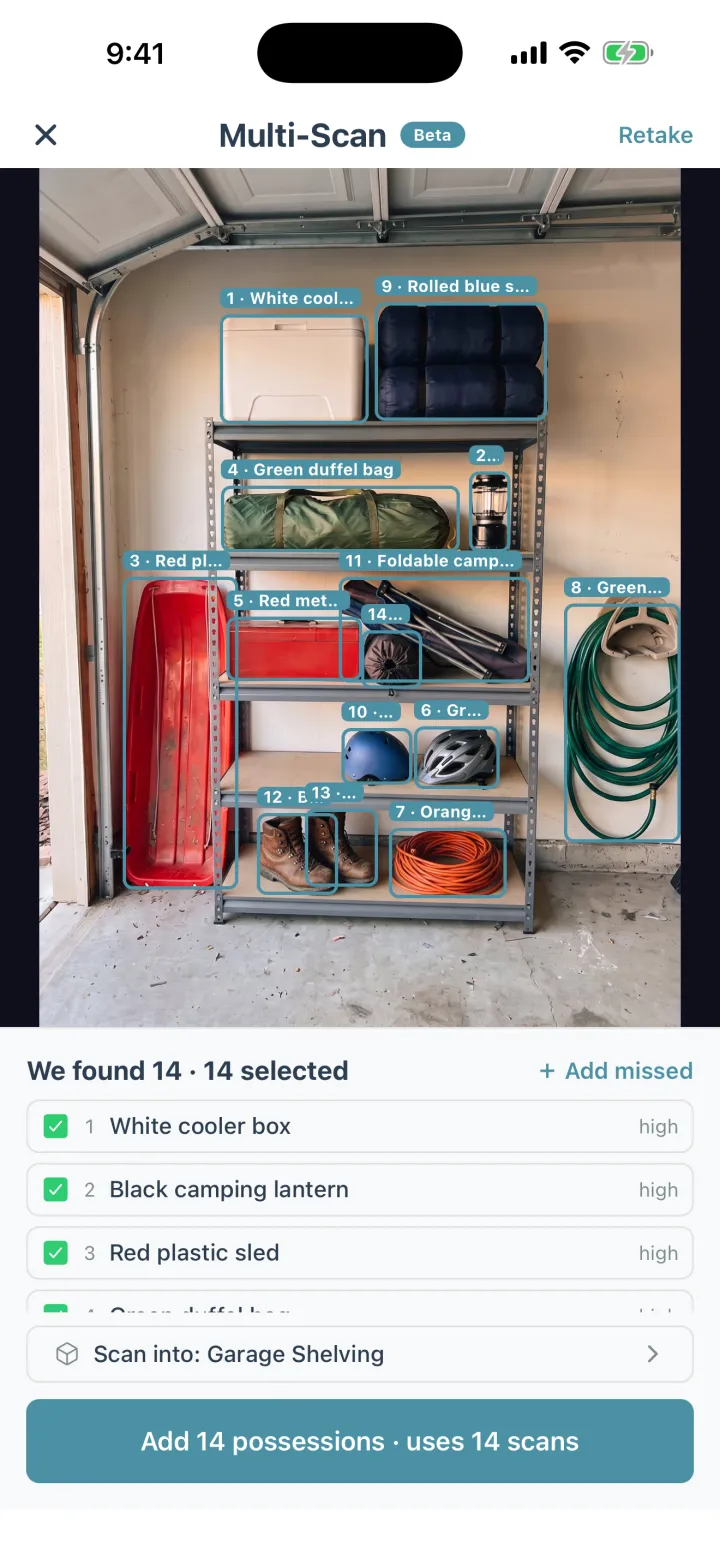
This is the step Cratify is built for. You photograph what goes into a box and the app identifies the items in the photo, so the record gets built while you pack rather than in a second pass afterward. A container can be a box, a shelf, a cabinet or a drawer, which matches how a garage is actually arranged instead of flattening it all into boxes. Each box can carry a printed QR label on the face that points out: scan it and the contents come up without opening it. Search for "sleeping bag" and it tells you which container, on which shelf.
Multi-Scan names up to 15 possessions from one photo.
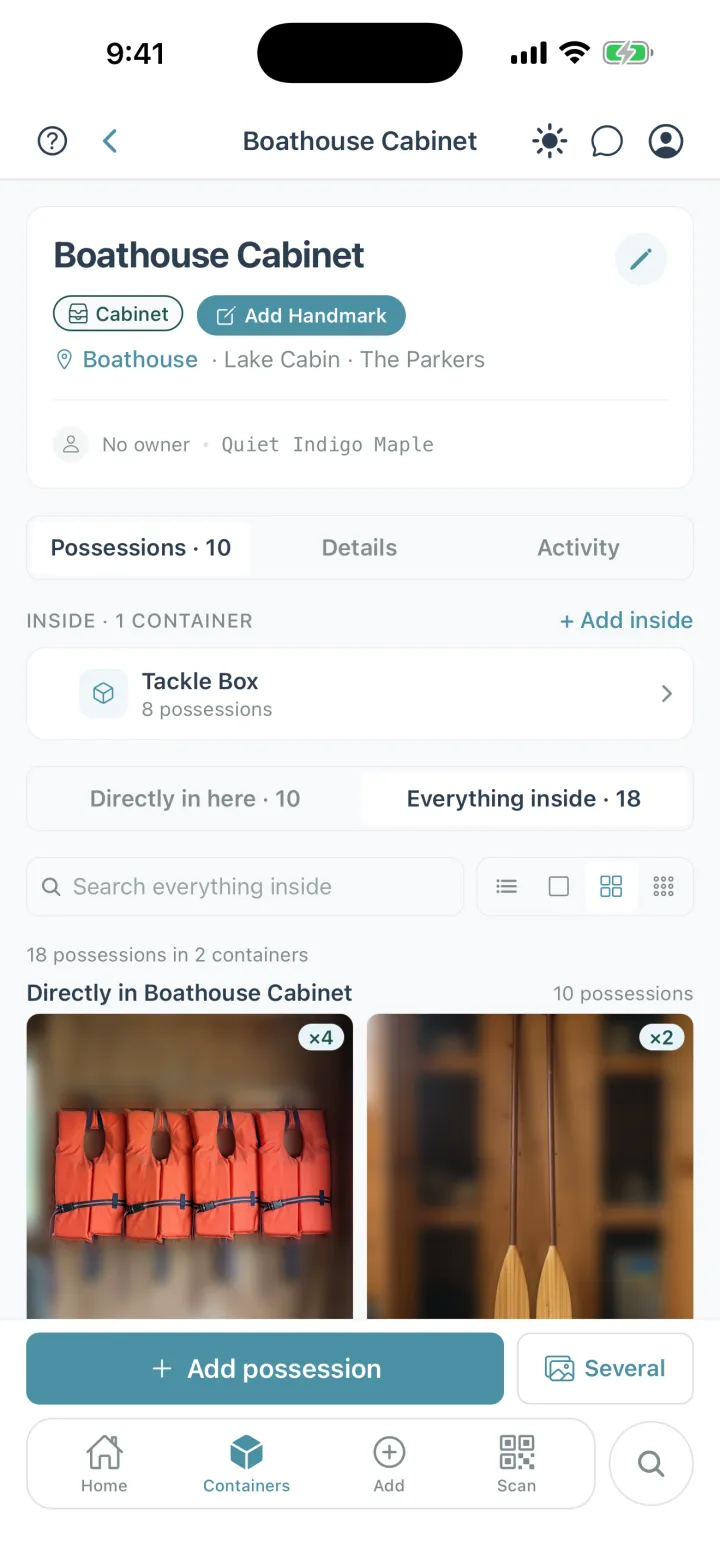
Containers inside containers, with everything inside listed.
Two related jobs fall out of this one. If the stays-here pile turns out to be bigger than the garage and part of it is heading to a rented unit, inventory the unit while you fill it rather than afterward — it is the same work at a fraction of the effort. And if your garage is where the team sports equipment lands every fall, it deserves its own container and its own list, because it moves in and out weekly and will otherwise reclaim the floor by October.
The twenty-minute reset
Put twenty minutes on the calendar at each change of season. Four times a year, not weekly, because weekly does not happen and a plan that assumes it will is a plan that fails in week three.
The reset is deliberately narrow:
Everything currently on the floor goes back where it lives, or gets a home decided for it on the spot.
The overhead zone swaps over: what is coming into season comes down, what is leaving goes up.
Anything that came back from a neighbor, or is owed to one, leaves the garage entirely.
Twenty minutes, four times a year, and the taped rectangle stays empty. That is what actually keeps a car in a garage — not the weekend in August, but the fact that nothing has quietly reclaimed the floor by the first hard freeze.
The shelves are the part everybody photographs. The record is the part still working in February. Cratify is free to try.
Reclaim the garage with Cratify
QR labels, photo inventory, and search for every box on the shelves — free to try.