How to Document Apartment Condition Before You Move In
You have the keys and the rooms are empty exactly once. Here is what a complete move-in condition record contains, room by room, and how to keep it findable a year later.

On this page
- Do it before anything comes through the door
- What a complete record actually contains
- Go room by room, and always in the same order
- The parts people miss
- Shoot it so it is still readable in a year
- Take a video, but do not lean on one
- Get it out of the camera roll the same day
- Then do it again on the day you leave
- What this record can and cannot do
The keys work on the second try. It is the middle of August, the apartment is empty in a way it will never be empty again, and there is a clean rectangle of paint on the living room wall where the last tenant's shelf used to be. You are standing there with your phone already out, because everyone told you to take photos, and you are not actually sure what you are taking photos of.
Here is the short answer. You are building a dated, room-by-room description of what this apartment looked like on the day it became yours, made before a single box crosses the threshold. It takes about an hour. The hour is the whole trick: a year from now, the difference between remembering a scratch on the floor and being able to point at a photograph of it gets decided today, while the rooms are empty and nothing is in front of anything.
Do it before anything comes through the door
An empty apartment is a one-time state. The moment the couch lands, roughly a fifth of the floor stops existing for photographic purposes and does not come back until you leave. Same with the wall behind the dresser, the corner where the desk goes, and the inside of the closet once there are clothes in it.
So the order is keys, walkthrough, movers. Not keys, movers, walkthrough-when-there-is-time. Mid-August this is a real constraint: leases turn over on the first and the fifteenth, trucks are booked in two-hour windows, and "I will do it tonight" becomes a photograph of a wall you can no longer see. If the truck is already at the curb, document the rooms that are still empty and finish the rest before you unpack them.
Budget 45 minutes for a one-bedroom and 90 for a house. Bring your phone, a charger, a pen, and something for scale — a coin, a key, a credit card. You want an item in the frame that tells a stranger how big the crack is.
What a complete record actually contains
Six pieces. A photograph missing one of them is still a photograph. It is just a weaker line in the record.
Date and time: your phone already writes these into the file. Do not screenshot your photos, do not send them to yourself through an app that strips the data, and do not re-save them. Move the originals.
One wide shot per room, taken from the doorway: the establishing frame. It is what ties the close-ups to this apartment and this room.
One close-up per defect: fill the frame with the damage. A scuff photographed from six feet away is a smudge nobody can identify later.
Scale in the frame: the coin, the key, your own hand. "A crack in the tile" and "a four-inch crack in the tile" are different records.
Function, not just appearance: run the tap, flush the toilet, open every window, light every burner, test the disposal, check that the closet door actually closes. A photograph of a faucet says nothing about the water pressure.
A written line per defect: room, exact location, what it is, roughly how big. The photograph shows it. The sentence is what makes the photograph findable a year from now.
Go room by room, and always in the same order
Pick an order and keep it. Front door, clockwise around each room, ceiling down to floor. The specific order matters less than using the same one everywhere, because that is what stops you from skipping the second bedroom and only noticing in June.
Entry and hallways: the door itself, both sides. The frame, the strike plate, the peephole. Every key you were handed, photographed together, with a count.
Kitchen: inside every cabinet and drawer. Under the sink with a light on, because that cabinet floor is where old leaks show. Behind and under the fridge if it rolls out. Inside the oven, the freezer, the dishwasher. Countertop edges. Burner grates.
Bathroom: grout lines, the caulk at the tub, the underside of the sink, the toilet base where it meets the floor, the extractor fan, the mirror edges. Run the shower for two full minutes and photograph the drain either keeping up or not keeping up.
Bedrooms and living areas: floors first, before anything is on them. Wall corners at eye level and again at floor level. Closet rods, closet shelves, and the inside of the closet door. Window screens, sills, locks, and the cord on every blind.
Shared and outdoor areas: the mailbox, the storage locker, the parking space, the basement, the laundry room, the balcony floor and railing. If your lease mentions it, photograph it.
Meters, alarms and filters: the electric and water meter readings on day one, the date printed on the smoke detector, the state of the furnace filter. These are numbers, and numbers age better than adjectives.
The parts people miss
Everyone photographs the obvious gouge in the living room floor. The list below is what tends to go undocumented, and it is disproportionately what comes up later.
The floor under where your furniture is about to go.
The back of every door and the top of every door frame.
Inside the medicine cabinet and the linen closet.
Window screens, which are easy to not notice missing.
The paint at the top of the walls, where a previous tenant's hooks were.
Anything the last tenant left behind, photographed where you found it, before you move it.
The lease itself and any condition form the landlord handed you, photographed or scanned on day one.
Shoot it so it is still readable in a year
Most of these photographs come out badly if you take them the way you take photographs of people. Light the subject, get close, hold still, take two of everything. The mechanics are the same ones covered in how to photograph your belongings for a home inventory, and they apply to a wall exactly as they apply to a possession: even light, plain background, no shadow of yourself across the frame.
Two habits are worth building on day one. First, photograph each defect twice — once with the room lights on and the flash off, once with the flash on. The flash finds texture the room light hides, and the room light finds discolouration the flash blows out. Second, when a defect is genuinely hard to see, put a finger in the frame next to it. It looks unpolished and it makes the photograph legible.
Take a video, but do not lean on one
A single continuous walkthrough clip is worth taking and is not a substitute for photographs. It is fast and it catches small defects you would never have thought to frame on their own.
What it is bad at is retrieval. A year later you have a nine-minute file, you know the scratch is in it somewhere, and finding that frame means walking the apartment again on a small screen. So narrate as you go, say the room name out loud, and treat the video as backup to the photographs rather than the other way round.
Get it out of the camera roll the same day
This is the step that gets skipped, and it is the one that decides whether the hour you just spent is worth anything.
The default home for 120 photographs of an empty apartment is your camera roll, in among nine thousand other photographs. They are dated, which is the part that matters, and they are also completely unsearchable. Next August you will be scrolling backwards through a summer looking for a picture of a windowsill. A paper condition checklist has the opposite problem: it is organised and legible and it has no photographs attached to a single line on it.
What you want is the middle of those two — the photographs grouped by room, each one attached to a written line saying what it is. That can be a folder per room in cloud storage with a text file beside it. It can be a shared album with real captions. It can be a home inventory app: Cratify models a place as a Location with Rooms inside it, so the record is organised the way the apartment is, and the lease and the condition form go in as Documents rather than as loose files in a downloads folder. Whatever you use, the test is the same. Can you find the photograph of the bathroom floor in under thirty seconds, without remembering the date?
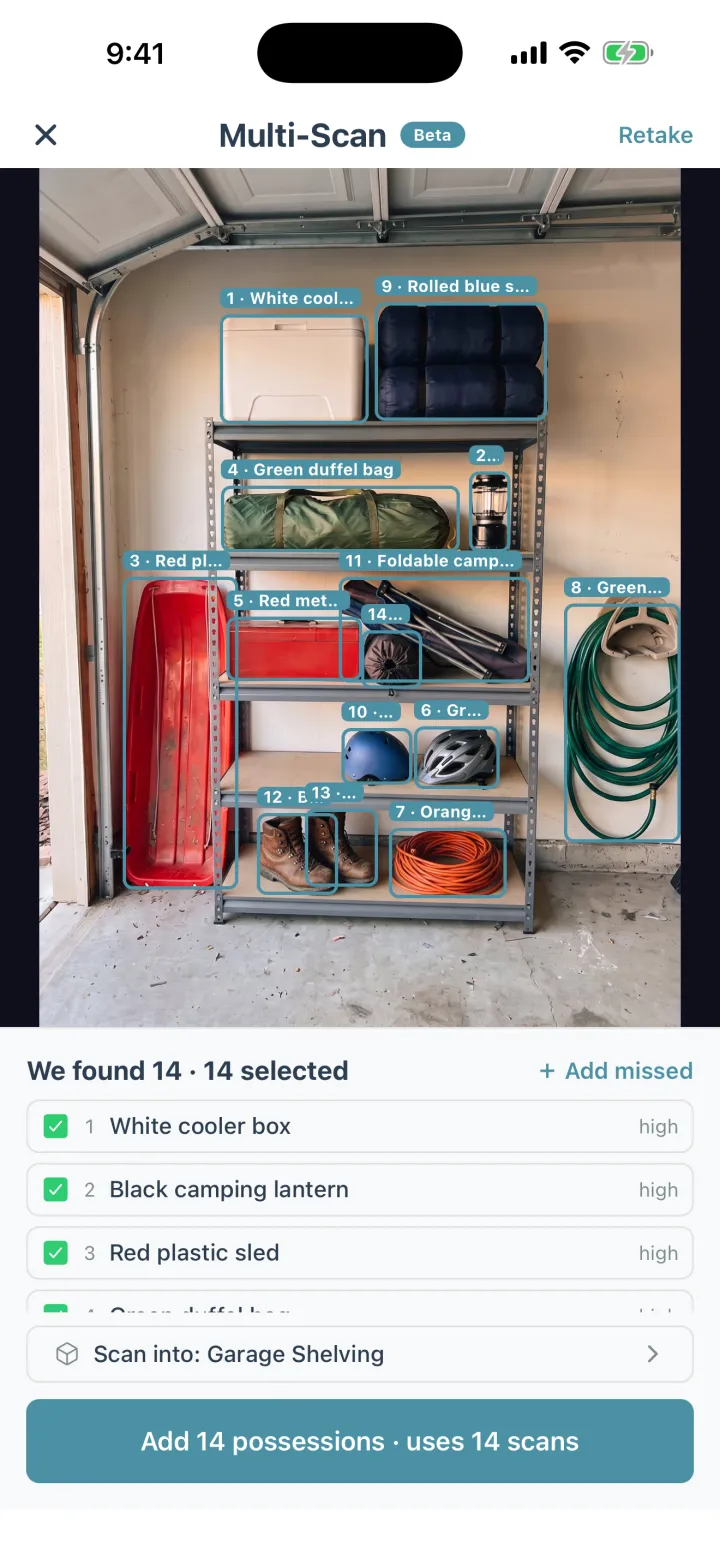
Multi-Scan names up to 15 possessions from one photo.
One separation worth making while you are in there: the apartment's condition and your own possessions are two different records. The first is about the place, its walls and its appliances. A home inventory is about what you carried in through the door. Same afternoon, same phone, different lists — and merging them makes both harder to use.
Then do it again on the day you leave
A move-in record only does its job if there is a move-out record shaped like it. Same rooms, same order, same shots, taken after the last item is out and before you hand the keys back. Two sets side by side describe the tenancy far better than either one alone.
If you are sharing the place, settle two questions before anyone signs anything: who is taking the photographs and where they live, and who owns which piece of furniture. The second one is worse than it sounds after two years and a couch bought jointly, and moving out of a shared apartment is where it comes due.
What this record can and cannot do
Be straight with yourself about the limits, because the internet is full of confident promises about deposits.
What you are building is a dated, room-by-room description of the apartment's condition on the day you took possession of it, with photographs and written lines attached. That is a factual record, and it is yours. How anyone else weighs it is not something a walkthrough decides, and any guide that tells you otherwise is guessing on your behalf. Read your own lease for what it says about condition reports and any window for returning one, and if the sums involved are serious, ask someone qualified rather than a blog.
The part you control is whether the record exists and whether you can find it. Both of those are settled in the first hour, on the one day the rooms are empty.
The keys are in your hand and the apartment is empty exactly once. Take the hour, put the photographs somewhere that will still make sense next August, and then go unpack. If you want the room-by-room version of that, Cratify is free to try.
Keep a record of your rental
A photo inventory of every room, searchable when move-out day comes — free to try.